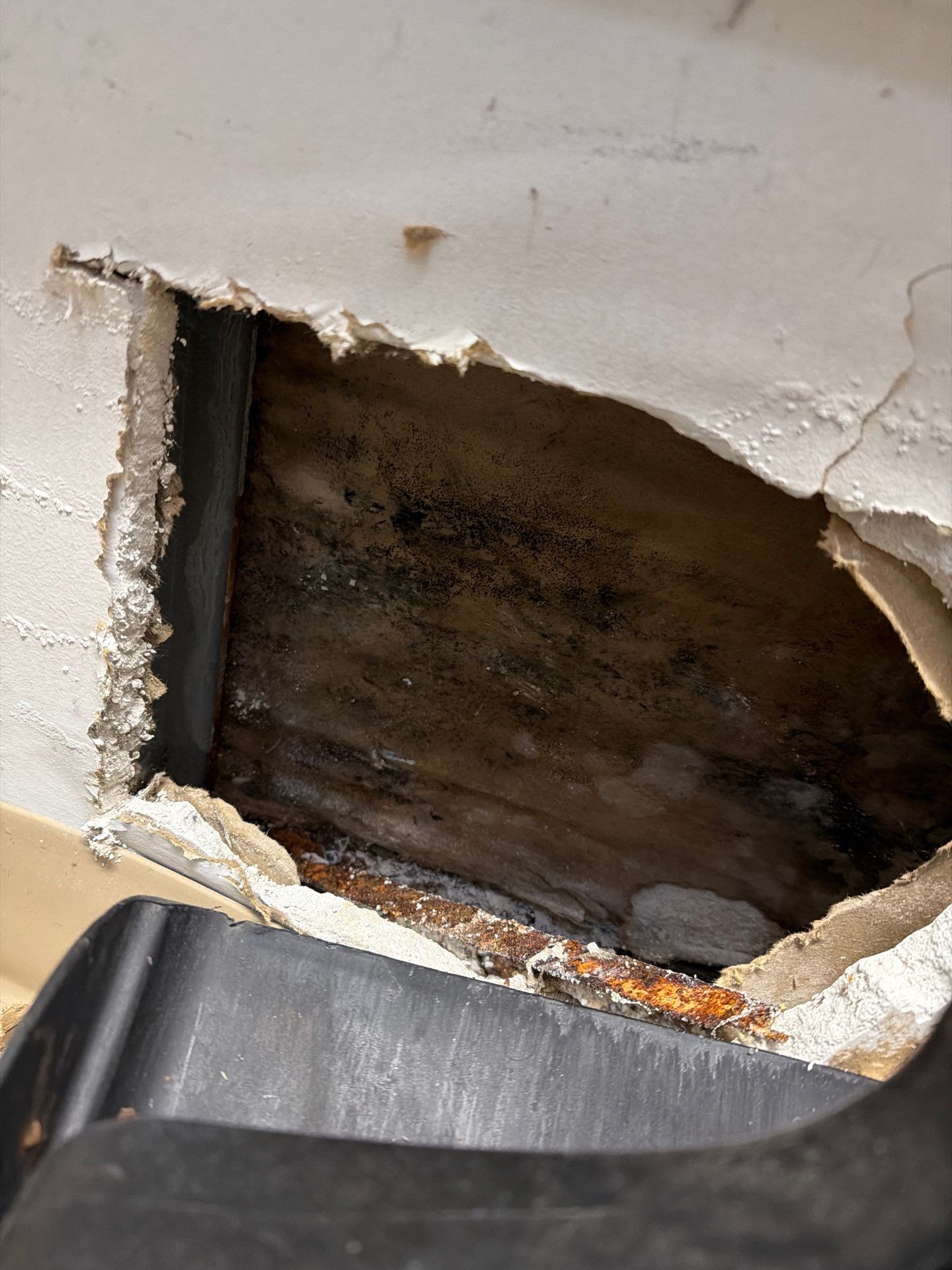
How Plumbing Leaks Actually Damage Walls and Floors
Water from a plumbing leak does three things at once. It saturates porous materials like drywall, insulation, and subfloor. It wicks upward through wall cavities by capillary action, sometimes 18 to 24 inches above the visible wet line. And it moves laterally along the path of least resistance, which is usually the seam between subfloor and bottom plate. That is why a leak under a Pebble Brook kitchen sink can show up two rooms away on a finished basement ceiling.
The IICRC S500 standard classifies these losses by water category and damage class. A clean supply line leak caught quickly is Category 1. The same leak after 48 hours, with bacterial growth starting in the drywall, becomes Category 2. A drain line or sewage leak is Category 3 from the moment it happens, and the affected materials usually cannot be saved. The class (1 through 4) describes how much material is wet and how hard it will be to dry. Class 1 might be a small wet spot on tile. Class 4 is hardwood, plaster, or concrete that has absorbed water deep into its structure.
These distinctions matter because they drive everything. They tell us whether your hardwood can be dried in place with mat systems or has to come up. They tell us whether the drywall gets cut at the standard 2 inches above the wet line or needs full sheet removal. They tell your insurance carrier what is reasonable to pay for. When we arrive, the first 30 minutes are spent moisture mapping with thermal imaging and pin meters so the scope reflects reality, not guesses. You can read more about how that mapping process works in our breakdown of water damage behind walls and hidden leak detection.
Older Pebble Brook homes add another layer of complexity. Plaster walls do not behave like modern drywall. They hold moisture longer, they resist surface evaporation, and they often hide wood lath that swells and warps as it dries. Homes built before 1978 may also contain asbestos in joint compound or vinyl flooring, which changes how materials can be removed. Pebble Brook Water Restoration technicians flag these conditions during the initial inspection so testing and abatement happen in the right sequence, before demolition starts.
Scenario Comparison: What Your Plumbing Leak Actually Costs
The table below reflects typical jobs we complete in Pebble Brook and surrounding central Indiana communities. Costs assume professional mitigation, drying, and repair of the affected area, not whole-room remodels. Insurance typically covers sudden and accidental leaks when reported promptly.
| Leak Scenario | IICRC Category | Typical Drying Time | Wall Repair Scope | Floor Repair Scope | Total Cost Range |
|---|---|---|---|---|---|
| Under-sink supply line, caught within 4 hours | Category 1 | 2 to 3 days | Cabinet kick removed, drywall dried in place or minor cut | Subfloor dried, finish flooring usually saved | $800 to $2,500 |
| Supply line behind wall, 24 to 72 hours undetected | Category 1 or 2 | 3 to 5 days | Flood cuts 2 ft up, insulation removed, anti-microbial applied | Subfloor often saved, finish floor depends on material | $3,500 to $8,000 |
| Frozen pipe burst in exterior wall | Category 1 escalating | 4 to 7 days | Full cavity opened, insulation replaced, pipe repair coordinated | Often two-room impact, hardwood frequently lost | $6,000 to $15,000 |
| Slab leak under concrete floor | Category 1 or 2 | 5 to 10 days | Lower drywall removed, baseboards replaced | Flooring lifted for slab access, plumber jackhammers, then restore | $8,000 to $20,000 |
| Drain line leak (kitchen, bath, laundry) | Category 2 | 3 to 5 days | Affected drywall removed and replaced, no dry-in-place | Subfloor usually replaced, finish flooring removed | $4,000 to $10,000 |
| Toilet supply or sewage line leak | Category 3 | 4 to 7 days | All porous materials removed in affected area | Subfloor cut out, joists sanitized, full reflooring | $6,000 to $14,000 |
Reading the Table for Your Situation
The numbers above tell a story most homeowners miss. The single biggest variable is not the size of the leak. It is how long the water sat. A pinhole that drips for a week behind drywall causes more damage than a dramatic burst that you catch in 20 minutes, because the slow leak creates the perfect environment for microbial growth and quietly destroys the structural integrity of subfloor and bottom plates. We routinely see jobs where the visible stain is the size of a dinner plate but the actual wet zone extends six feet in every direction inside the cavity.
The second pattern: floor type drives cost more than wall area. A leak in a tiled bathroom with a concrete substrate is often the cheapest scenario because tile sheds water and concrete does not absorb it the way wood does. The same leak in a room with engineered hardwood over plywood subfloor doubles or triples the repair cost because both layers usually have to come out. Laminate is the worst offender, since the fiberboard core swells permanently on first contact with water and no amount of drying restores it. If you are weighing whether to save your floors, our guide on hardwood floor water damage and save-or-replace decisions covers the moisture thresholds we use.
The third pattern is insurance behavior. Sudden leaks (a burst supply line, a failed fitting, an appliance hose) are almost always covered. Long-term seepage that you should have noticed is almost always denied. That is why documentation matters. We photograph every moisture reading, every cavity, every removed material, and we provide carriers with a complete scope written in the language they use. When that documentation is solid, claims close faster and at full value. For a deeper look at how full restoration jobs are priced, see our water damage restoration cost breakdown.
What to Do in the First Hour
Shut the main water valve, not just the fixture stop, since fixture stops fail under pressure. Cut power to any wet outlets at the breaker. Move furniture and rugs off wet flooring to prevent stain transfer. Then call Pebble Brook Water Restoration. The faster moisture mapping happens, the cheaper your repair becomes.